
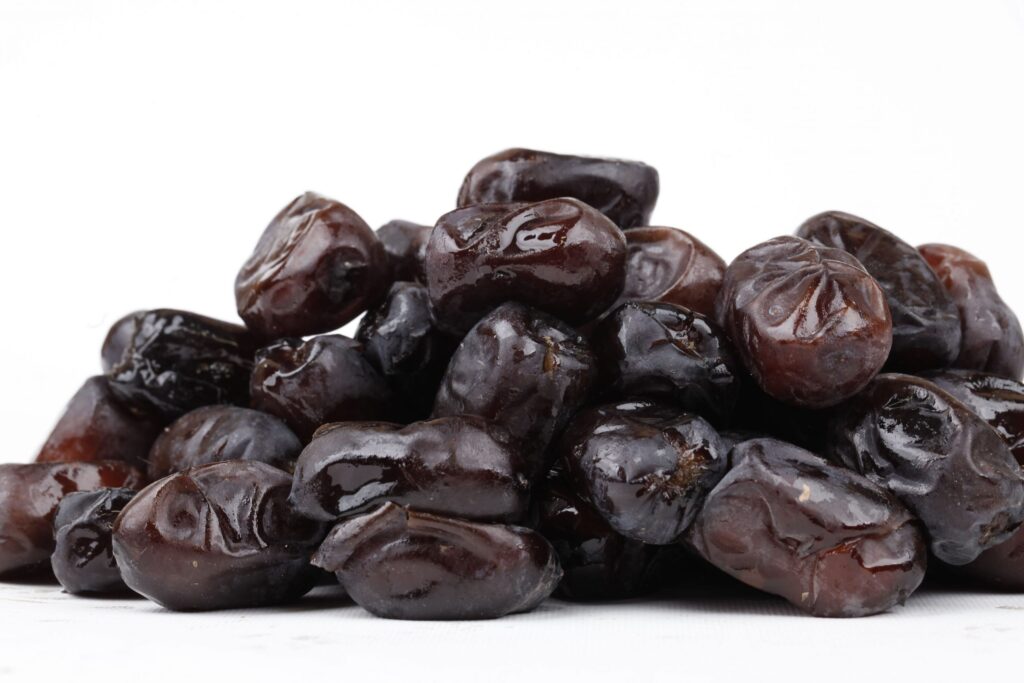
Mazafati is a dark, very soft date from Bam, in Kerman province, Iran. It holds a lot of moisture and needs refrigeration. This guide is written for anyone pricing a "mazafati dates 5kg carton" for a shop, a café or a large event. It looks at where the 5 kg figure comes from, what one Malaysian wholesaler's price list actually showed on 28 November 2026, and how to keep a box of soft dates in good shape once it reaches you.
Where the 5 kg box comes from
The 5 kg figure comes from the export trade. In its handbook on date palm cultivation, in a section on packing fruit intended mainly for export, the FAO describes the bulk pack plainly: dates "are usually packed in cardboard boxes", sometimes inside plastic bags "for additional protection and preservation of moisture". It gives the usual weight as "5 kg or 15 lbs.", depending on the country where the fruit was grown or where it will be sold.
The same passage explains what happens next. Bulk fruit "may be handed over to be repacked in the countries where it is to be marketed", with retail packing done to the customer's requirements. So the packet on a shop shelf may have started life inside a larger box. FAO does not name Mazafati in this passage. It describes bulk packing for dates in general.
Malaysia has no commercial date-growing trade, so every Mazafati date sold here has been imported. Whatever box it arrives in, it has travelled from Iran.
Mazafati dates 5kg carton: what one Malaysian list showed
On 28 November 2026 we checked the live price list of one Malaysian wholesaler. It had 65 listings. Of those, 27 came to 5 kg in total weight and 12 of the 27 were in stock. None of the 27 was Mazafati, and none carried the Bam name.
Three rotab listings on that list came in a different shape: twelve packets of 600 g, which is 7.2 kg in all. Two named the variety or the town, and the third simply said "Rotab".
| Listing name (as on the list) | Pack | Price | Per kg | Stock on 28 Nov 2026 |
|---|---|---|---|---|
| Rotab Mazafati AAA 12pkt × 600gm | 12 × 600 g = 7.2 kg | RM86 | RM11.94 | Out of stock |
| Rotab BAM AAA 12pkt × 600g | 12 × 600 g = 7.2 kg | RM88 | RM12.22 | Out of stock |
| Rotab 12pkt × 600g (variety not named) | 12 × 600 g = 7.2 kg | RM90 | RM12.50 | Out of stock |
All three were out of stock that day. Mazafati is cold-stored and sold year-round, so read a sold-out listing as one seller's stock position on one date, nothing more. The prices belong to that wholesaler and will move with stock and promotions.
For a sense of scale, the cheapest in-stock 5 kg packs on the same list were Mariami A Normal at RM75 (RM15 per kg) and Safawi Premium A No.2 (Mini) at RM80 (RM16 per kg). On a per-kilo basis, the three 12 × 600 g rotab listings were lower than every in-stock 5 kg pack on the list. Mariami and Safawi are different dates, though. Mariami is an Iranian date that is dark, semi-dry and chewy. Safawi comes from the Madinah region and is dark brown to black, soft and chewy. Neither is a stand-in for Mazafati.
Twelve packets or one block
A 7.2 kg pack of twelve 600 g packets and a single 5 kg box are not the same purchase, even if the price per kilo looks close. With packets, you open one at a time and the other eleven stay closed in the chiller. With a single 5 kg box, every time the lid comes off, the whole 5 kg is out of the cold.
For a café or a stall that goes through a few hundred grams a day, packets are easier to manage. For a kenduri where the whole box goes out on trays the same afternoon, a single box makes no difference. Work out how fast you will use it before you choose the format.
Keeping a box of soft dates cold
The FAO handbook is direct about soft, fresh-ripe dates. Of the rutab stage it says: "Unless they are cold stored, the fruits quickly turn sour and become of no commercial value." It also notes that dates at every stage except tamar "are perishable, due to their high water content". Rotab is the soft, fresh-ripe stage, and Mazafati is cold-chained so that rotab Mazafati can be sold all year. That chain has to carry on all the way to your fridge.
The box itself needs some thought. In its section on storage, FAO warns that "cardboard is sensitive to humidity" and that "various plastics are sensitive to low temperatures". Look at the packaging as well as the fruit when you unpack.
Two published studies on Mazafati give a feel for how the fruit holds up in storage, although neither tested a 5 kg box. A 2015 study, aimed at export products of Kerman province, packed Mazafati dates in polymer films containing silver nanoparticles and stored them, with control samples, at four temperatures. The authors found the best storage temperature was 4°C, and dates packed in the film with 5% nano-silver had a maximum shelf life of 53 days. A 2025 study looked further back, at the palm. It found that the leaf-to-bunch ratio in the orchard changed how well Mazafati kept in storage. After 60 days, the group with the highest ratio (2.5–3) had lost more than 10% of its weight, while the 2–2.5 ratio group lost at most 3.61%.
You cannot see the orchard from a shop in Klang. What you can do is ask when the stock was packed and how it has been held since. If you plan to keep stock for longer, our guide to freezing and thawing Mazafati dates sets out what FAO and the UK Food Standards Agency say about the freezer.

Planning how much to order
Demand for dates in Malaysia peaks before and during Ramadan. Hari Raya, weddings (hantaran), kenduri and umrah gifts are other peaks. A soft date needs fridge space, so the size of your chiller sets a limit on how much you can take in at once.
Some simple arithmetic helps. One 12 × 600 g pack gives you twelve packets, so a stall selling two packets a day would get through it in six days. A caterer putting out 600 g on each tray needs one packet per tray. Count your fridge shelves before you count the boxes.
Transport is the other gap. FAO notes that temperature matters "especially for fresh dates at Khalal or Rutab stage" and recommends a temperature recorder in the container or truck. It is fair to ask a supplier how the stock travels and whether it is kept cold on the way.
What to ask before you order
A bulk quote is only useful if you can compare it with another one. Ask for these details in writing:
- the variety name on the label (Mazafati, or the Bam name), not just "rotab"
- the net weight of each packet and of the whole pack
- the grade, and what that seller means by it
- the price per kilo, so a 7.2 kg pack and a 5 kg box can sit side by side
- how the stock is stored and delivered
Grades such as A, AA, AAA or Jumbo are each importer's own size sorting. They are not an international standard, so an AAA from one seller may not match an AAA from another. For a worked example of turning a bulk quote into something you can compare, see this guide to working out a fair quote per kilo for Sayer, a semi-dry Iranian date from Khuzestan. The variety is different, but the per-kilo method carries over.
If you also want the label side of things, Mazafati dishes: what the nutrition data shows looks at the nutrition data for this date.
Common questions
Is a "mazafati dates 5kg carton" sold in Malaysia?
On the one wholesaler's list we checked on 28 November 2026, no Mazafati pack weighed 5 kg. The three 12 × 600 g (7.2 kg) rotab listings, one of them named Mazafati, were out of stock that day.
Is 5 kg a standard box size for dates?
FAO gives 5 kg or 15 lbs as the usual weight of a bulk date pack, depending on the country of production or sale. It describes bulk dates in general and does not single out Mazafati.
Do Mazafati dates need to go in the fridge?
Yes. Mazafati is very soft and high in moisture, and it needs refrigeration. FAO says rutab fruit turns sour quickly unless it is cold stored.
Does AAA mean the same thing from every seller?
No. Grades such as A, AA, AAA and Jumbo are each importer's own size sorting, so compare packs from the same seller or ask what the grade means.
Before you order anything listed as a "Mazafati dates 5kg carton", ask for the packet weights, the grade and how the stock has been kept cold, then work out the price per kilo yourself. More about this site is on the About Us page and the contact page.